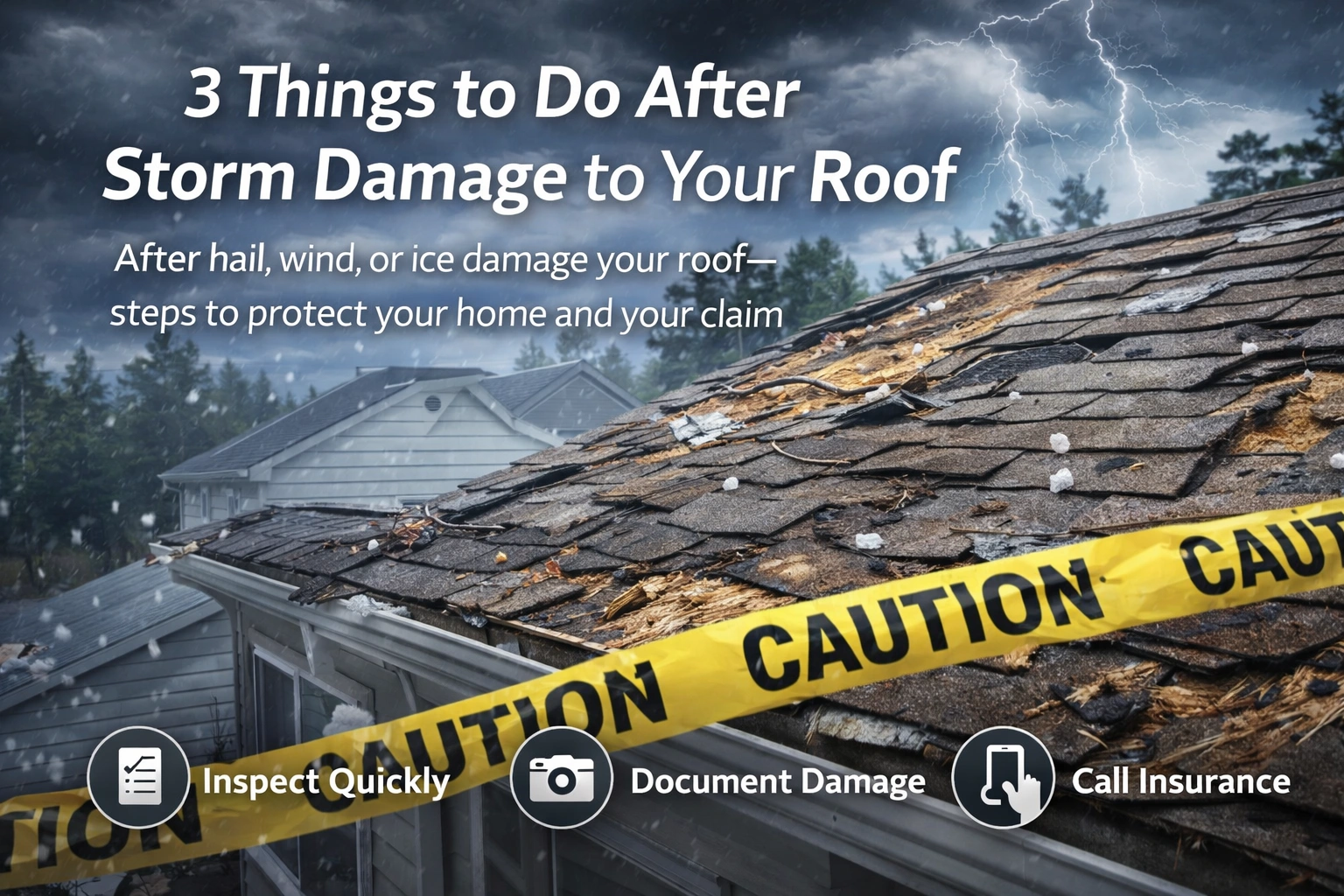
3 Things to Do After Storm Damage to Your Roof
- Document everything with photos before you touch anything or sign anything.
- Get an independent inspection from a licensed local contractor — before you call insurance.
- Call your insurance carrier with the inspection report and photos in hand.
You heard the storm roll through last night, or you noticed the damage this morning — shingles in the yard, a stain on the ceiling, dents in the gutters that weren’t there yesterday. It’s stressful, and the instinct is usually to call your insurance company first and ask what to do.
That’s the wrong order.
This guide walks through the three things every Racine homeowner should do after a roof-damaging storm, in the order that protects your home, your insurance claim, and your wallet. It takes about ten minutes to read. The first step you should take in the next hour.
Document everything before you touch anything
Photos are your single most important asset in the next 48 hours. Adjusters make decisions based on documentation, and contractors need specifics to give you accurate estimates. The more thorough your documentation, the better every downstream conversation goes.
Walk the perimeter of your house with your phone camera and document:
- Every side of the house from the ground, zoomed out enough to show the full roofline
- Close-ups (using your phone’s zoom) of any visible damage — missing shingles, lifted edges, dark spots where granules have been knocked off
- The gutters and downspouts — dents are a reliable indicator of hail, and granule buildup in gutters after a storm points to shingle damage above
- Debris in the yard — photograph where you find displaced shingles, not just that you found them
- Any damage to your AC condenser, window screens, siding, or painted surfaces — these are often used by adjusters to corroborate roof damage
- Inside the house: ceilings, upper walls, attic spaces if you can access them safely. Even small stains can point to bigger problems up top
Write down the date and time of the storm. If you’re not sure exactly when it hit, the National Weather Service office in Milwaukee publishes storm event summaries you can reference — timing matters for insurance. Screenshot local news reports, radar images, or any NWS bulletins that confirm severe weather in your area that day.
If you’re seeing damage that needs immediate attention — a hole in the roof letting water in, or a detached section — document the damage first, then cover it. Tarps, buckets, and any emergency mitigation you do are usually reimbursable under your policy as long as you keep the receipts. Take photos of the damage before and after tarping.
Get an independent inspection before you call your insurance
This is the step most homeowners skip, and skipping it is expensive. Here’s why the order matters.
When you call your insurance carrier first, they schedule an adjuster to visit — usually within a few days to a few weeks depending on how many claims the storm generated. The adjuster’s job is to estimate the cost of repairing damage they can verify. But adjusters are often under time pressure, they don’t always walk the roof, and they’re working for the insurance company, not for you. Hidden damage — lifted shingles that look fine from the ground, compromised flashings, bruised shingles that will fail in a year — frequently gets missed.
If the adjuster misses it, you sign off on a lower claim, repairs get made, and then six months later you’re calling back because the roof is still leaking. Now you’re arguing about whether that’s new damage or damage from the original storm, and the insurance company has leverage.
A licensed local roofing contractor doesn’t have that conflict of interest. Their inspection is focused on one thing: what’s actually wrong with your roof and what it will take to fix it correctly. A thorough inspection means walking the roof itself (not eyeballing from the driveway), checking the attic for leaks and ventilation issues, and taking detailed photos of every area of concern. The resulting written report gives you specifics when you talk to your adjuster, and makes it much harder for damage to be missed or minimized.
Inspections from licensed local contractors are almost always free. Axis offers them for Racine-area homeowners at no charge, and most reputable local contractors do the same. It’s part of how we win work.
One critical warning: be cautious of contractors who knock on your door within 24 to 48 hours of a storm, especially those with out-of-state plates. Wisconsin’s Office of the Commissioner of Insurance has issued guidance about this pattern because some of these contractors pressure homeowners into signing contracts on the spot, offer to “cover” deductibles (which is illegal insurance fraud in most states), or disappear after collecting a deposit. A licensed local contractor with a real Racine-area business address and a long track record is a safer bet.
Storm damage in the last 48 hours?
Call Rich directly. He’ll walk your roof himself and give you an honest report — no sales pressure, no upfront cost, no obligation.
Call (262) 822-1231 Request a Free InspectionCall your insurance carrier with documentation in hand
Now you’re ready to open a claim. You have photos of the damage, a written inspection report from a licensed contractor, timing confirmation for the storm, and (if applicable) receipts for emergency mitigation. This puts you in a much stronger position than most homeowners.
When you call, have your policy number and the inspection report handy. Ask your carrier:
- What’s my deductible on this claim? Roof claims sometimes carry a separate wind/hail deductible that’s different from your standard deductible
- Is my policy ACV (Actual Cash Value) or RCV (Replacement Cost Value)? RCV pays to replace with new materials; ACV depreciates based on roof age. This significantly affects what you’ll receive
- What’s the timeline for adjuster assignment and estimate? After major storms this can stretch to several weeks
- Is the damage type covered? Hail and wind are almost always covered; some policies exclude certain kinds of weather events
- Do I need to get estimates from multiple contractors? Most policies don’t require this, but some do
Once the adjuster visits, you’re entitled to be present during the inspection. Bring your contractor’s inspection report and the photos — pointing out specific damage the adjuster might otherwise miss is legitimate and protects the claim.
If the adjuster’s estimate seems low or misses damage your contractor identified, you can ask for a re-inspection or request that your contractor and the adjuster meet on-site to walk through the discrepancies. Many carriers will accommodate this.
Two things to avoid during this process. First, don’t sign an “Assignment of Benefits” (AOB) that transfers your insurance claim rights to a contractor. Legitimate contractors don’t require this; it’s a red flag when they do. Second, don’t work with any contractor who offers to “waive” or “cover” your deductible — this is insurance fraud in Wisconsin and puts you at legal risk along with the contractor.
Insurance policies and claim processes vary significantly. The guidance above covers general patterns, but your specific policy terms matter. Your insurance carrier or a licensed public adjuster can give you advice specific to your claim.
What NOT to do — the most common mistakes
- Don’t climb on the roof yourself. Wet shingles are slick, damaged decking can give way, and any injury becomes your problem rather than a contractor’s insurance claim.
- Don’t sign anything within the first 24 hours. High-pressure contractors count on stress-driven decisions. Any reputable contractor will give you time to think and compare.
- Don’t pay upfront in full. Standard practice is a reasonable deposit (typically a percentage of the job or materials costs), with the balance on completion. Paying the full amount upfront is how homeowners end up with a half-finished roof and a contractor who doesn’t return calls.
- Don’t hire door-to-door contractors from out of state without verification. If you’re tempted, at minimum verify their Wisconsin dwelling contractor license through the state DSPS lookup and ask for a Racine-area business address and references you can actually call.
- Don’t assume the roof is fine because it “looks okay” from the ground. Some of the most expensive damage is invisible without a proper inspection.
- Don’t throw away debris or damaged shingles. Your adjuster may want to see them, and they help document what happened and when.
- Don’t wait weeks to act. Wisconsin weather is unforgiving, and small damage often becomes big damage after the next storm. It also creates timing problems with insurance claims.
How long do I have to act after storm damage?
Most Wisconsin homeowner insurance policies require you to report damage within a specific window — commonly 30 to 60 days, though this varies by carrier. Check your policy or call your insurance company to confirm the exact timeline for your coverage.
Practically speaking, sooner is much better than later. Wisconsin’s freeze-thaw cycles, follow-up storms, and seasonal weather can turn a minor leak into major interior damage within weeks. Some policies also limit coverage if damage worsens because it wasn’t reported promptly — meaning a small claim you could have filed in April becomes a disputed claim by July.
Emergency tarping or temporary repairs to prevent further damage are almost always covered as mitigation expenses, so there’s no reason to wait on those. If you’re unsure whether to file a claim at all, the order still holds: document, inspect, then call your carrier with specifics and ask the question with real information in hand.
If a second storm hits before you’ve dealt with the first, file separately for separate events. Combining them usually hurts your claim and can create coverage disputes.
Frequently asked questions
What should I do first after storm damage to my roof?
Document everything with photos before you touch anything. Walk the perimeter of your house and photograph every side from the ground, plus any interior ceiling stains, debris in gutters, and displaced shingles in the yard. Save the date and time of the storm. Only after documenting the damage should you call a licensed local contractor for an independent inspection — and only after the inspection should you call your insurance carrier. Doing these three steps in this order protects your home, your insurance claim, and your wallet.
Should I file an insurance claim for roof damage?
Every policy is different, so the answer depends on your specific coverage, deductible, and the extent of damage. In general, it’s worth filing when the inspection confirms damage that exceeds your deductible by a meaningful amount. If the damage is close to or below your deductible, filing may not be worth it and could affect future premiums. Get an independent inspection first so you know what you’re dealing with, then talk to your insurance carrier about whether filing makes sense for your situation.
How long do I have to file a roof damage claim in Wisconsin?
Most Wisconsin homeowner policies require you to report damage within a specific window — commonly 30 to 60 days, though this varies by insurer. Check your policy or call your carrier to confirm the exact timeline. Don’t wait — Wisconsin weather can make minor damage worse quickly, and some policies limit coverage if damage worsens because it wasn’t reported promptly. Emergency tarping to prevent further damage is usually covered as mitigation.
Can I inspect my roof myself after a storm?
Stay on the ground. Walk the perimeter of your house and look for visible damage — missing shingles, debris, granules in gutters, ceiling stains inside. Use binoculars or your phone’s zoom to check closer detail. Do not climb on the roof yourself. Wet or damaged shingles are slick, and damage to the decking underneath can create hidden weak spots. A licensed contractor has the safety equipment and training to walk the roof properly and will spot damage that’s invisible from the ground.
Who should I call first — my insurance or a roofing contractor?
For most homeowners, getting an independent inspection from a licensed local roofing contractor before calling insurance makes sense. The inspection documents the full extent of the damage — including hidden damage that adjusters sometimes miss on a quick walkthrough — and gives you specificity when you do talk to your carrier. Calling insurance first without knowing what the damage actually is can lead to undersold claims and missed damage that becomes your problem later.
How do I know if my roof has hail damage?
Hail damage on shingles looks like dark circular spots where granules have been knocked off — usually the size of a quarter or half-dollar, concentrated on the sides of the roof that faced the storm. Other ground-level indicators include dents in gutters, downspouts, window screens, air conditioner fins, and painted surfaces. Not all hail damage is visible from the ground, so a full roof inspection by a licensed contractor is the only reliable way to assess it.
What is a “storm chaser” contractor and why should I be cautious?
“Storm chaser” is industry shorthand for contractors who travel from out of state to areas hit by storms, often knocking door-to-door within 24 to 48 hours. Wisconsin’s Office of the Commissioner of Insurance and similar state regulators have issued guidance about these operators because they sometimes pressure homeowners to sign contracts quickly, offer to “cover” deductibles (which is illegal insurance fraud in many states), or disappear after collecting payment. Licensed, locally based contractors are almost always the safer choice — they’ll still be around in five years if a warranty issue comes up.
Dealing with storm damage right now?
Rich has walked hundreds of storm-damaged roofs in the Racine area for nearly two decades. Free inspections, written reports you can share with your insurance, no pressure to sign anything.
Call (262) 822-1231 Request a Free InspectionThis article is for general informational purposes and reflects Axis Construction & Remodeling’s experience serving the Racine, Wisconsin area. Every insurance policy and claim situation is different. Nothing in this article should be taken as legal, financial, or insurance advice — for guidance specific to your claim, consult your insurance carrier, a licensed public adjuster, or another appropriate licensed professional. For an accurate assessment of your roof, request a free in-person inspection.